We develop custom AI assistants, RAG chatbots, and automations and integrate them into your existing software, data sources, and workflows. We start with a bounded use case, examine privacy and the consequences of errors, and make quality measurable. If classic software solves the task more reliably, we say so.

Start with the use case, not the model

AI solutions for specific tasks in your organization

A useful AI feature starts with a clearly bounded task. What matters is not which model is currently best known, but which information it processes, who uses the result, and what happens when it is wrong. As a custom software development partner, we build the surrounding application as carefully as the AI itself.

AI assistants

Answers questions from approved knowledge or guides people through a complex choice.

Works well when:

People must find the right answer among many options or documents, and the assistant can rely on approved sources.

Better without AI when:

A clear menu, a good search, or a simple form already gets people to the right result.

Personalization

Adapts content and recommendations to the usage context.

Works well when:

There is enough reliable usage data and genuinely different content or options to recommend.

Better without AI when:

There is too little data, or everyone would receive essentially the same content anyway.

Automation

Prepares recurring steps across documents and connected systems.

Works well when:

A step requires interpretation, but the result can be checked before it has consequences.

Better without AI when:

Every result must be exactly reproducible and every value must be correct. Classic rules are more reliable here.

Examples of bounded use cases

Internal knowledge assistant

Answer questions from approved manuals, policies, product information, or project documents. The assistant cites its sources and respects the access rights of the signed-in person.

Service and selection assistant

Answer customer questions or guide people through a complex choice. Unclear or binding cases are handed over to a person instead of being answered with invented certainty.

Document processing

Extract information from emails, forms, invoices, or reports, classify it, and suggest the next step. Rules or responsible employees verify the result before it becomes binding.

Copilot for specialist workflows

Summarize cases, draft replies, and make relevant suggestions directly in an existing specialist application. The decision remains with the responsible person.

Bounded AI automation

Prepare several steps across connected systems, such as gathering information or creating a draft. Critical actions require explicit permissions, logging, and approval.

Personalization and recommendations

Adapt content or suggestions to the usage context. This is worthwhile only when there is enough reliable data and genuinely different options to recommend.

Choose the right level of autonomy

AI assistant, chatbot, or AI agent: what is the difference?

The terms are often used interchangeably, but they describe different scopes. The more a system can do on its own, the more important permissions, traceability, cost limits, and human approval become.

AI chatbot
Conducts a dialog and answers questions. It is suitable for support, advice, and orientation when answers come from defined sources and its limits remain visible.
AI assistant
Supports a task within a website or application. In addition to dialog, it can summarize content, prepare data, draft suggestions, or guide users through a specialist workflow.
AI agent
Uses tools and interfaces to carry out several steps. Its scope must be bounded through permissions, logs, technical limits, and approvals before actions affect real systems.
Rule-based automation
Produces the same predictable result for clear inputs and rules. We use classic logic wherever interpretation is unnecessary and exact reproducibility matters.

A useful assistant needs more than a prompt

Integrate AI into existing software and data sources

A completely new application is rarely necessary. We usually add a clearly bounded AI component to an existing website, specialist application, or platform and connect it to the information, roles, and workflows that are already in place.

  1. 01

    Sources

    Documents, CMS, databases, CRM, ticket systems, and internal APIs.

  2. 02

    Permissions

    Roles and tenant boundaries determine which information may be used.

  3. 03

    Retrieval and model

    Relevant context is selected and processed by a suitable model.

  4. 04

    Application

    The assistant works inside the interface and process people already use.

A measured pilot instead of an isolated model demo

Implement AI: from a suitable use case to controlled operation

  1. Check the task and consequences of errors

    We describe the current workflow, expected benefit, and consequences of a wrong result. The outcome is a reasoned choice between AI, classic logic, or a combination of both, with clear success and exclusion criteria.

  2. Clarify data, permissions, and operation

    We assess sources, data quality, access rights, interfaces, and privacy requirements. The outcome is a solution design with documented data flows, responsibilities, and a realistic range of effort.

  3. Build and evaluate a bounded pilot

    We implement one complete use case with real sources and test it against representative questions, documents, and edge cases. The outcome is measured quality, not a demo that works only with ideal examples.

  4. Integrate it into everyday work

    After a successful evaluation, we connect the assistant to the existing interface and required systems. Approvals, fallbacks, and handovers are designed for the people who use the workflow.

  5. Monitor quality, costs, and changes

    Models, data, and usage change. We monitor answer quality, error patterns, response time, and costs, then adjust sources, prompts, rules, or models in a controlled way.

Separate implementation effort from operating costs

What does a custom AI assistant cost?

Model usage is only one part of the cost. The greater effort often lies in preparing data, connecting systems, implementing permissions, fitting the assistant into the workflow, and testing quality reliably. We make initial and ongoing costs visible separately.

Use case and success criteria
The task, its boundaries, representative test cases, and the consequences of errors determine how much discovery and validation is needed.
Sources and data quality
Scattered, outdated, or inconsistent information must be organized before an assistant can use it reliably.
Interfaces and user experience
Connections to existing software and a suitable interface often matter more than the chat window itself.
Permissions, security, and privacy
Sensitive data, roles, audit trails, deletion rules, and regulatory requirements shape architecture and testing effort.
Model, hosting, and usage
API calls, local infrastructure, search, storage, response time, and usage volume determine the recurring technical costs.
Monitoring and continuous improvement
Quality checks, updated sources, provider changes, support, and further development belong in a sustainable operating budget.
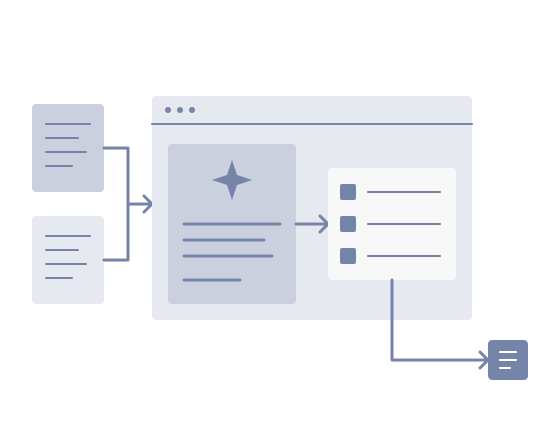

Confidence comes from controls, not confident wording

Operate AI with privacy and verifiable quality

An AI system is not reliable because a model sounds convincing. What matters is which data it may see, how results are tested, and what happens when an answer is uncertain or wrong.

Documented data flows

We record which data is processed, why it is needed, where it is stored, and when it is deleted. Confidential content is not passed to an external service without review.

Roles and permissions

Access to knowledge and actions follows the rights of the existing application. An assistant must not bypass role, department, or tenant boundaries.

Representative quality tests

Real questions, documents, and edge cases show whether answers are correct, sufficiently supported, and complete enough for the intended use.

Safe limits and handovers

Uncertain, sensitive, or binding cases are handed over to people. Actions use approvals, technical limits, and traceable logs.

How we measure whether the assistant really helps

Before the pilot, we agree on evidence of a useful result. Alongside model quality, we examine the complete workflow: whether people reach a supported answer faster, manual preparation falls, and unclear cases are recognized reliably.

  • Correct and sufficiently supported answers
  • Reliable recognition of uncertainty
  • Saved processing time per case
  • Adoption in everyday work
  • Cost per successfully handled case
  • Response time and availability

AI integration and software quality from one team

Why Naymspace

First the task, then the model

We assess benefit, error consequences, and alternatives before selecting a model. This produces a durable software feature instead of a demo that convinces only in an ideal example.

The complete integration from one team

A useful assistant needs more than good prompts. We connect the interface, data sources, permissions, integrations, tests, and operation in a maintainable application.

Quality remains verifiable

We test with representative cases, make sources and limits visible, and monitor quality and costs after launch. Critical decisions remain with the responsible people.

What clients often want to know before a pilot.

Frequently asked questions about AI assistants and integration

What is a custom AI assistant?

A custom AI assistant supports a defined task within your website or application. It can answer from approved knowledge, summarize cases, prepare data, draft suggestions, or guide users through a specialist workflow. Unlike a general-purpose tool, it follows your sources, permissions, interfaces, and quality requirements.

What is the difference between an AI chatbot, assistant, and agent?

A chatbot primarily conducts a dialog. An assistant supports a broader task within an application, while an agent can use tools and interfaces to carry out several steps. The greater the scope of action, the more important permissions, logs, cost limits, and human approvals become.

How does a RAG chatbot work with our own data?

With Retrieval Augmented Generation, the assistant first finds relevant content in approved sources and gives it to the language model as context. This keeps knowledge updateable and allows sources to be shown without training a custom model for every change. Good source material, permissions, and representative tests remain essential.

Can we add AI to our existing application, or do we need something new?

Usually we add it to the existing application. AI is a component, not a reason to rewrite everything. What matters is where the relevant data sits, which interfaces exist, how permissions work, and how cleanly the current software can be extended.

How do we know whether AI is worth it for us at all?

We examine whether the task requires interpretation, whether an occasional error can be caught before it has consequences, and whether suitable source material exists. We also define the expected improvement, such as less manual preparation or faster access to supported answers. If classic logic is better, we recommend that instead.

What does a custom AI assistant cost?

The model itself is often the smaller part. The greater effort usually lies in preparing data, connecting existing systems, implementing permissions, fitting the assistant into the workflow, and testing quality. We therefore separate implementation effort from recurring model, hosting, monitoring, and maintenance costs.

How long does a first AI pilot take?

The duration depends on the data sources, interfaces, permissions, and required quality tests. We begin with one bounded use case. Once real data and representative test cases are available, the pilot can be evaluated before a larger productive rollout begins.

Do we need our own data or our own AI model?

You often need your own approved content, but rarely a self-trained language model. In many cases it is more effective to connect a suitable existing model to your data sources and application in a controlled way. We consider a custom or locally operated model when privacy, quality, costs, or independence genuinely justify it.

How do you deal with wrong or invented answers?

We restrict sources and tasks, test with representative cases, and make uncertainty visible. Depending on the risk, rules or people verify a result before it becomes binding. Generative models cannot guarantee complete freedom from errors, so handling errors is part of the product design.

Where is our data processed, and what about GDPR?

We decide that for each use case. We document which data is transferred, where it is stored, and when it is deleted. Depending on the requirements, European providers, dedicated infrastructure, or local operation may be suitable. We coordinate the concrete setup with your privacy and security responsibilities before development.

Who operates and maintains the AI after launch?

We do, if you want us to. Models, providers, data, and usage change over time. We monitor answer quality, response time, costs, and errors, then update sources, test cases, prompts, rules, or models in a controlled way.

Is an AI assistant the right choice for your use case?

Tell us which task, data, and existing software are involved. We will give you an honest assessment of whether AI is suitable and what a useful first pilot could look like. We reply within 24 hours.

Portrait of Sebastian Müller
Sebastian Müller

Trusted by

Please give us at least one way to reach you: email or phone.

By submitting you agree to our privacy policy. We only use your data to answer your request.